


A comprehensive overview of current industrial product label printing technologies.
Printing is the process of copying image content onto various materials. In this article, we will introduce the industrial printing industry, which is an essential part of the publishing process for publications and labels today.
1. Offset Printing
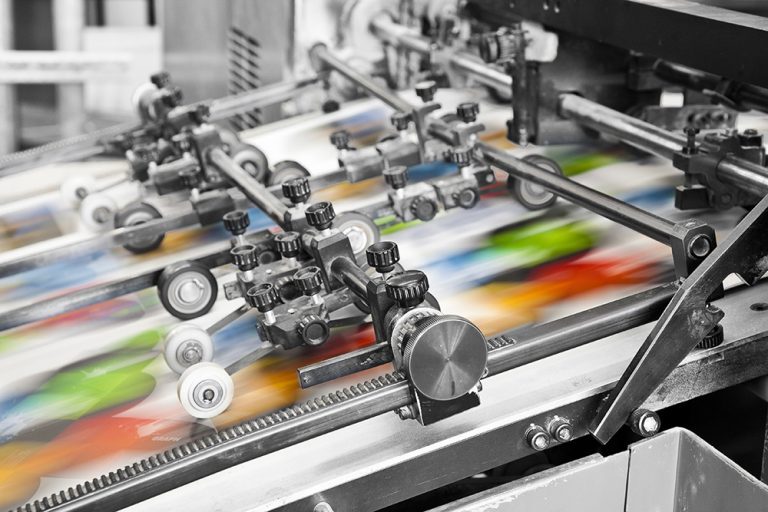
Offset printing technology
Offset printing is the most common form of industrial printing today. Offset printing is the process of transferring information from a printing plate onto the surface of the printing material using monochrome or multi-color inks under pressure from a device called a printing press.
Basic features of compensation technology
Offset printing is a printing method based on the principle of flat printing, meaning that images, text, and unprinted areas on the printing plate are all at the same height.
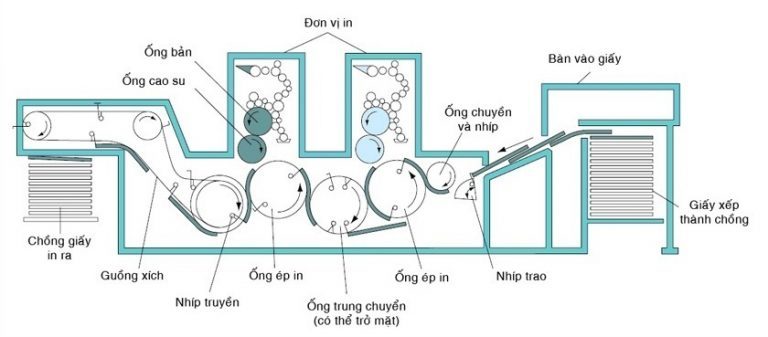
Diagram of a 2-color sheet-fed offset printing machine.
The operating principle of offset printing
On the printing plate (zinc), the required printing elements, not the print elements, are transferred onto the rubber printing plate. When printed onto the surface of the printing material, this creates the desired image.
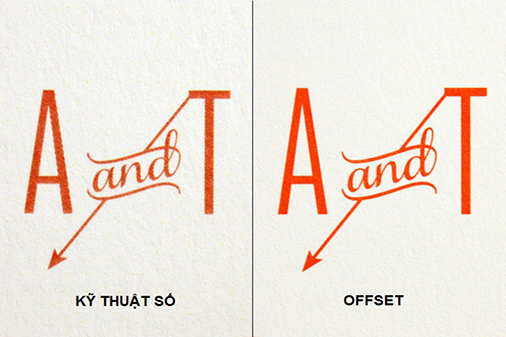
How to identify offset printing
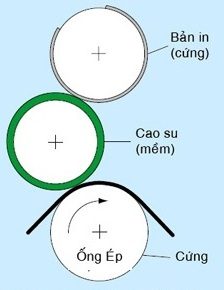
Offset printing operating principle
Offset printing technology produces high-quality, sharp products, making it ideal for printed materials such as books, newsletters, catalogs, marketing brochures, and other essential business publications.
Offset printing machines are usually imported from countries such as Germany, the USA, and Japan, including brands like Komori, Heidelberg, and Roland.
2. Flexographic Printing Technique
Flexographic printing is a highly efficient printing system (the ink receives an anilox stream and immediately transfers the ink onto the printing material).
Flexographic printing is a system for relief printing, where information, images, etc., on the printing plate are raised above the non-printing elements. The image used is a reversed image that is then printed onto the object to be printed, resulting in the image in the correct format.
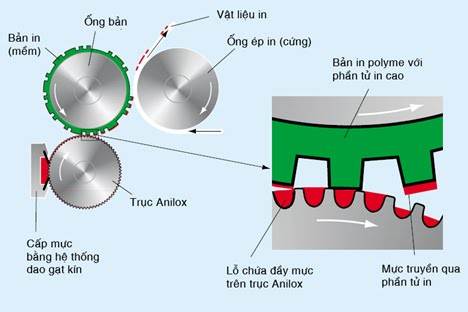
Understanding the Flexo Printing Method
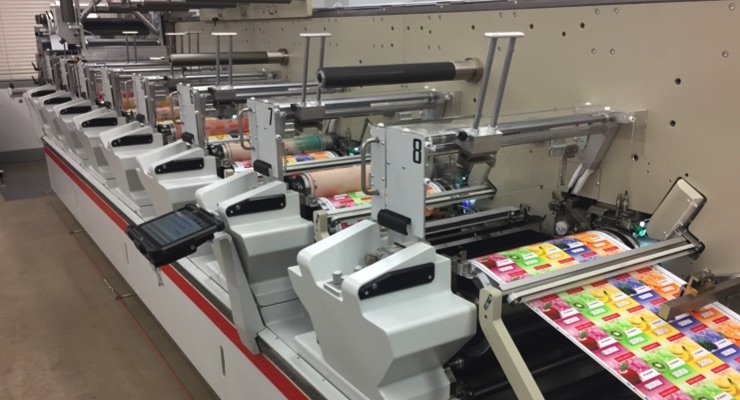
Flexographic printing technology does not produce prints of the same high quality as offset and gravure printing if high-resolution images are required. Anilox roll flexographic printing typically produces uniform ink distribution, offering advantages in print quality and vibrant colors due to the use of 150 DPI screen printing.
Flexographic printing technology is widely used and has great potential for development due to its advantages in meeting large-scale production plans and the ability to print on roll materials for automatic gluing machines.
Flexographic printing technology is particularly notable for its automatic breakage system that activates immediately after printing. If the printing material is adhesive, any excess material will also peel off the backing. Flexographic printing is a suitable option for printing labels, stickers, tags, packaging, cartons, and can be used on a variety of special materials…
3. Copper Plate Printing
Gravure printing is a direct printing method that creates intaglio printing, where the printed elements are recessed and uneven compared to the unprinted elements. That is, on a printed circuit board, the image or text (called the printed elements) is etched into the metal surface.
During the printing process, two stages occur: Ink (in liquid form) is applied to the surface of the pressure pump, and the ink also flows into the pressing part of the pressure mechanism. Then, a device called a doctor blade wipes the ink from the surface of the printing plate. As printing progresses, the ink in the chambers under printing pressure is transferred onto the material surface.
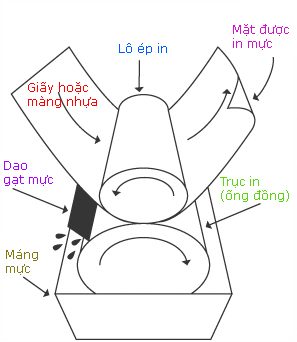
Gravure printing technique
Understanding gravure printing:

Direct ink transfer to the printing material, simplest printing unit configuration, image reproduction with depth and accuracy, high printing intensity.
Gravure printing offers higher accuracy and image quality reproduction compared to flexographic printing, and the offset resistance of large printing plates allows for reprinting. Gravure printing is applied to a wide variety of materials such as paper, flexible plastic films, thin metals, PE, OPP, PET, etc.
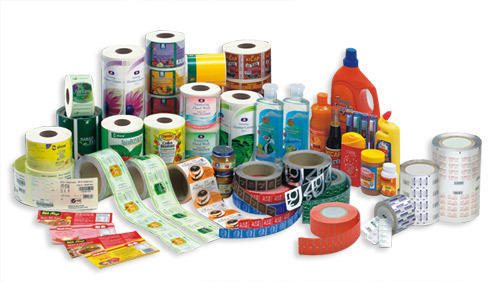
Gravure printing is widely used in the packaging industry: for cleaning products, confectionery, coffee, food, etc.
Disadvantages:
Solvent-based gravure printing inks are highly toxic to the environment and humans, and their high initial cost necessitates large order volumes.
4. Digital printing
Digital publishing is the process of publishing digital images directly onto various media. Digital printing is commonly used in professional printing systems serving small to medium-scale printing needs. Laser printers and inkjet printers are the two most popular types of digital printers.
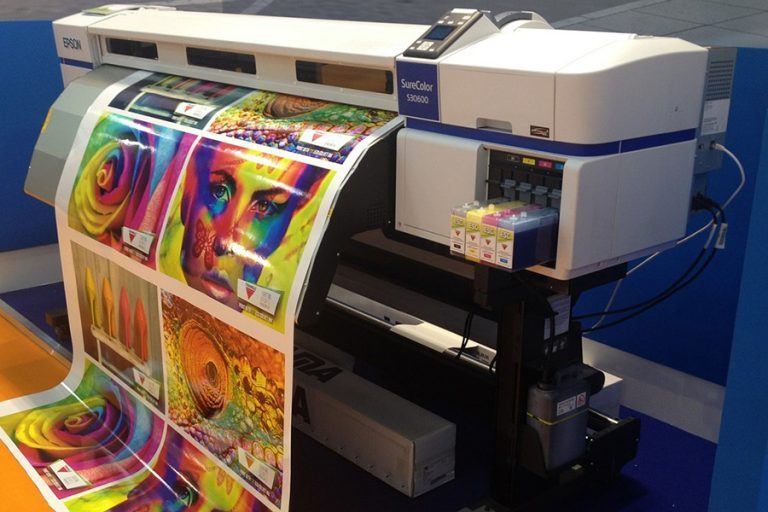
Current digital printing samples
Inkjet printing: Inkjet printers operate on the principle of inkjet printing (as the name suggests). Ink is sprayed through tiny holes in droplets at high speed (approximately 5000 per second), creating a small ink mark to produce a sharp print.
Most inkjet printers are generally black and white printers. A minimum of three inks are needed for printing. Colors are produced by mixing these three primary colors together.
5. Laser Printing:
A laser beam scans the photosensitive drum through a continuously rotating polygonal mirror. The laser then scans the drum's surface (the intensity of this beam varies depending on the density of each pixel and flickers. A smooth surface reduces the film's resistance).
At different locations, the laser beam has different intensities and different resistances; when it passes over a high-voltage power line, it will acquire varying amounts of electrical charge.
Low places do not attract squid, while high places do.
The amount of ink used depends on the strength of the electrical charge generated as the drum passes through the ink cartridge to create the content on the glass surface to be printed.
When the map is too blank, the content of the page to be printed will be transferred to paper.
The toner powder will dissolve as the paper passes through the heat-sealed roller. The temperature of the melting roller is approximately 250 degrees Celsius, and along with the pressure of the melting roller, the lost toner will be forcefully pressed onto the paper.
Color laser printers operate on the same principle as black and white laser printers, the only difference being that they don't have toner cartridges for the primary colors: black, yellow, magenta, and cyan; the combination of these colors allows for color printing.
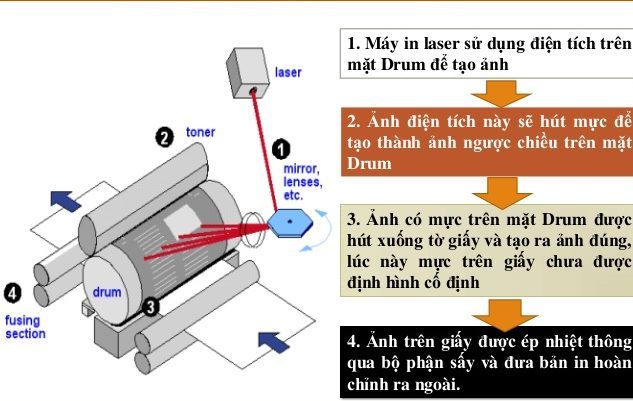
Laser printer
6. Screen printing, also known as silk screen printing.
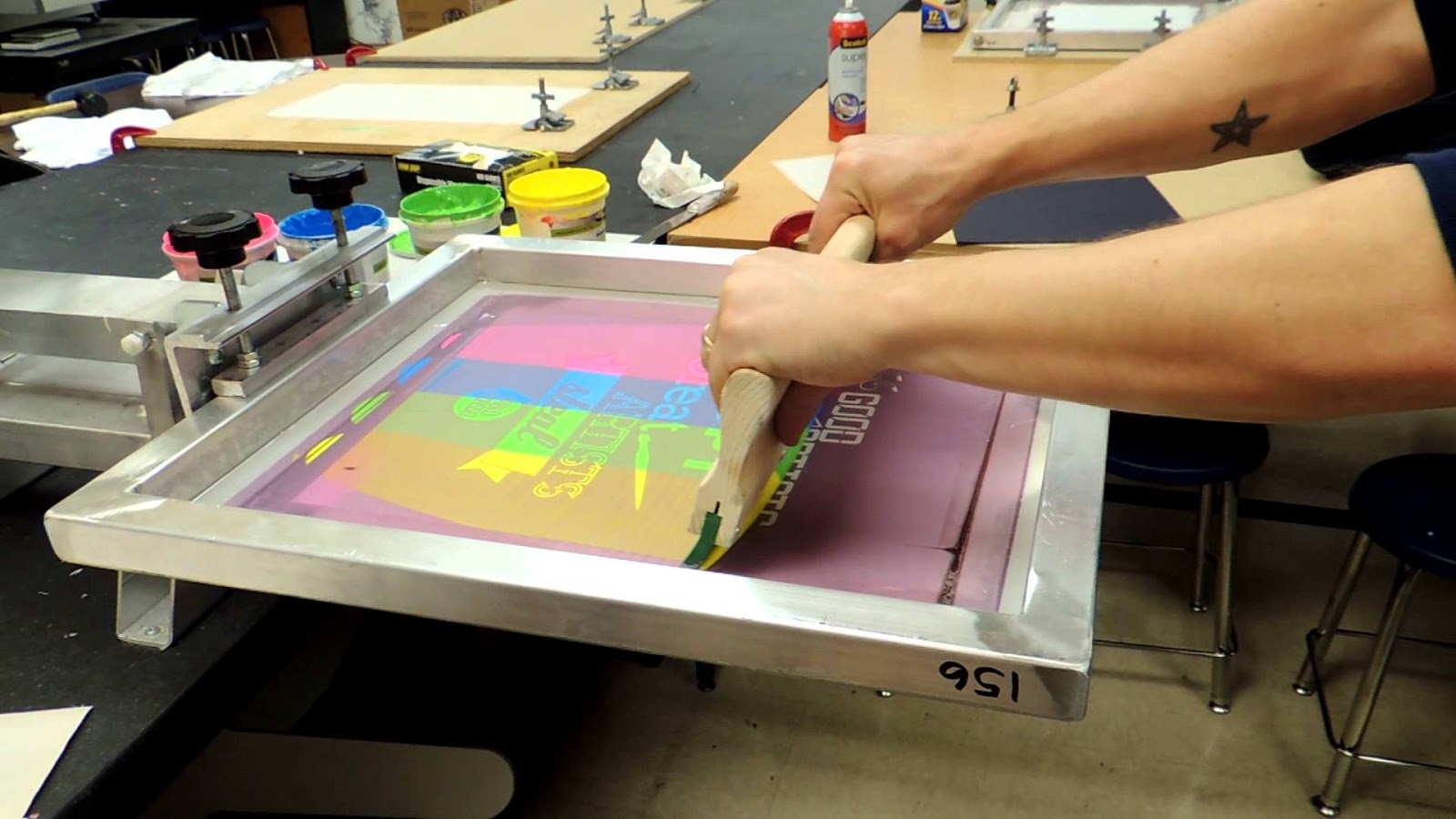
This printing method is one of the oldest printing techniques. Screen printing is a type of printing technique based on the principle that ink permeates through a mesh, and the image is printed onto the surface of the material because a portion of the mesh has been previously sealed with chemicals.
The screen printing process uses a wooden frame and then stretches a thin sheet of silk to create the frame. Therefore, this printing method was formerly called screen printing, and later, with the availability of alternative materials such as cotton fabric, woven fabric, and metal mesh, it was generally referred to as screen printing technique.
Besides the screen frame, an important tool in this printing technique is an ink-resistant material used for spreading the ink, called a "knife." The knife is a tool used to spread the ink so that it passes through the printing mesh, transferring the ink to the product being printed.
The printing process can be done manually or by machine, but regardless of the method used, the most important requirement for the printing bed is that it must be flat, sturdy, and have its own elasticity so that the printing plate can make contact with the flat surface.
Share:


