


Advantages and disadvantages of RFID in manufacturing.
1. Advantages:
- No line of sight adjustment is required . For display assemblies where barcodes may be obscured, or in applications where objects are painted or exposed to processes (such as pharmaceuticals) that could damage or destroy the barcode, RFID is the best option.
- RFID tags will remain in place, and the reader will capture the code without worrying about visibility.
It's easy to overwrite or edit tag data. Suitable for applications where RFID tags are shipped to bins or suppliers rather than a unit or component. - Product-specific and flexible data modification capabilities can make tags more useful for tracking in highly demanding manufacturing operations.
- Optimize asset tracking. Many companies use RFID to track containers, pallets, and other expensive assets. A return on investment is generated by optimizing assets and avoiding unnecessary purchases, as well as ensuring the traceability of the container and its contents.
- Increase supply chain visibility. Barcode scanning requires human action to provide location updates, and those scans only occur occasionally. With RFID, measurements can be automated and more frequent. It provides a more accurate overview of manufacturing operations with real-time updates.
- Inventory counting is easier. The fact that RFID in manufacturing automates traditional handles can help reduce costly labor expenses. You can complete orders in minutes, with minimal staff.
- Cost-effective. RFID hardware tends to be less expensive.
Furthermore, RFID is superior to traditional barcode formats. The table below shows the difference in efficiency between RFID and barcodes.
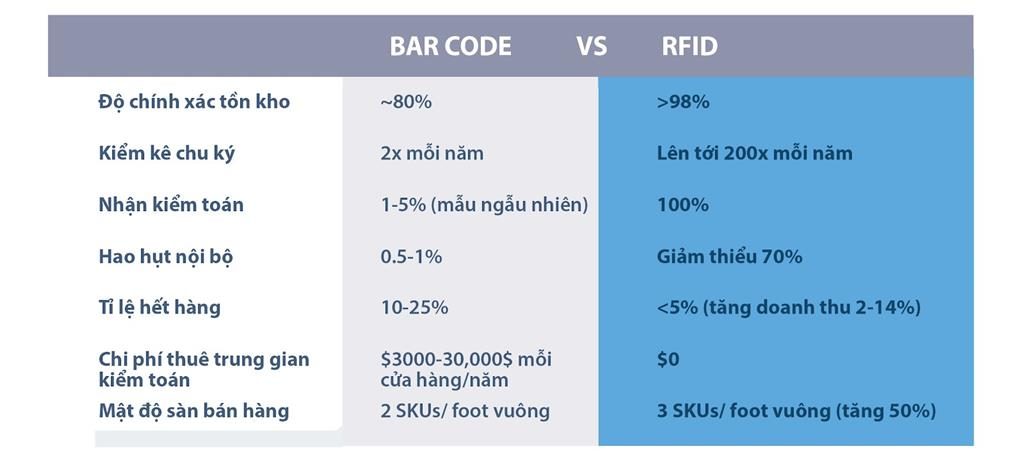
Advantages of RFID
2. Disadvantages:
- RFID is more expensive than barcodes. Inexpensive finished products are very costly to label with RFID. However, RFID can provide ROI by labeling more expensive parts or items, and in the case of a closed-loop application involving reusable assets (such as pallets), the cost of the tags can be amortized over a long period.
- Most trading partners do not utilize RFID. To fully leverage RFID in manufacturing, suppliers and consumers will need the ability to label goods at their facilities or read RFID tags. Without their presence (which comes with a price), there will be gaps in visibility.
- RFID is more complex than barcodes. RFID readers must be carefully configured to ensure they can successfully scan 100 percent of the tags. That's why RFID needs to be tested more frequently than barcodes to ensure the solution is functioning properly. Manufacturing environments often contain large amounts of metals, liquids, and chemicals – all of which can hinder RFID technology. However, it can also be difficult to improve reading speed and remote performance.
- Data processing. RFID tags provide more information than barcodes, but you need a business system to process that information and turn it into useful business data. Otherwise, your system may be cluttered with unnecessary information.
RFID in manufacturing can offer several advantages, but not all manufacturers benefit from the same advantages. Before implementation, companies should conduct a thorough business analysis to see what RFID can solve, as well as whether the ROI can support the investment.
Share:


