


ADVANTAGES, DISADVANTAGES, AND APPLICATIONS OF FLEXO PRINTING TECHNOLOGY IN PRINTING
Flexography is a direct printing technology that produces raised prints. It's a modern version of embossing. Flexography can print on any surface, including plastic, metallic film, cellophane, and paper. Flexography is commonly used for printing labels, packaging, paper bags, cardboard boxes, and especially roll-fed printing.
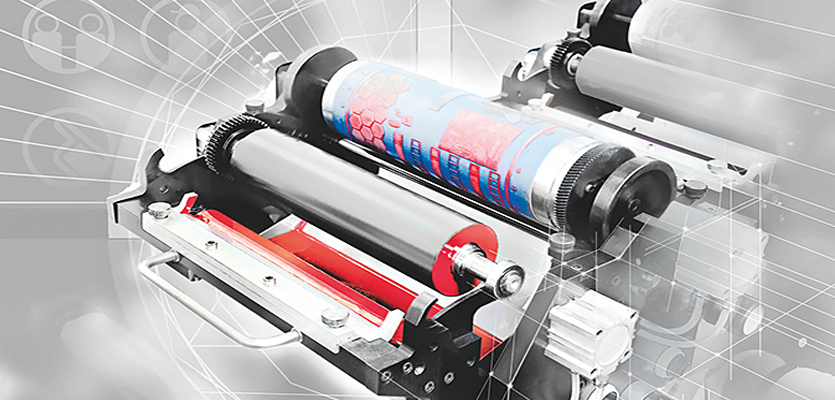
BASIC STRUCTURE OF A FLEXO PRINTER:
- The metering roller is a cylindrical shaft partially submerged in the ink tray. Its function is to transfer ink from the ink tray to the anilox roller. It is also known as the metering roller.
- Anilox roll : This is a metal roller with a textured surface featuring numerous small recessed compartments that act as ink wells. When ink is supplied from the ink supply roller, the ink droplets are collected in the ink wells on the anilox roll.
- Doctor Blade : To prevent excess ink from adhering to the anilox roller surface and potentially smudging the print, a doctor blade is used to remove excess ink from the anilox roller. The doctor blade is made of steel or polymer.
- Plate Cylinder : Made of rubber material, used to attach the printing plate to a surface using adhesive tape, magnetism, or secure locking pins.
- Flexographic Printing Plate : Made of photopolymer plastic. Printing plates can be manufactured using photochemical methods, CTP, or laser engraving. The thickness, rigidity, or flexibility of the printing plate depends on the printing material (paper, cardboard, or film).
- The compression cylinder is made of rubber. Its function is to press the surface of the material to be printed against the cylinder attached to the printing plate, transferring ink from the printing plate to the printing surface.
- Ink Tray: The tray that holds the ink for refilling.
LABEL PRINTING PROCESS USING FLEXO PRINTING TECHNOLOGY:
TYPOGRAPHY – PRINT FILE PROCESSING
To produce high-quality, defect-free flexographic prints, the prepress stage on the computer is extremely important. Prepress involves processing the design file, arranging the print sheets, laying out the pages, leveling the pages, and setting the CMYK color gradients. Prepress typically uses specialized design software such as Illustrator, Corel Draw, Adobe Acrobat, etc., and the final output film file is in PDF format.
OUTPUT FILM
CTF (Computer-to-Film) technology is used in which digital data from a computer is converted into analog data on film via film recorders. A film set typically consists of four films representing the colors C (Cyan), M (Magenta), Y (Yellow), and K (Black). These film sets are in black and white.
DRY THE PRINTING PLATES
After the film is produced, these film sheets are laminated onto printing plates; these film-laminated plates are then placed in a plate exposure machine; based on the photochemical principle, areas without the elements to be printed will be eroded. The printed elements and halftones that light cannot penetrate or only partially penetrate will be eroded or partially eroded.
Note: Nowadays, with more advanced technology, manufacturers have created machines that record images directly onto the printing plate – these are called plate recorders or CTP – Computer to Plate.
FLEXO PRINTING
The printing plates are attached to the plate mounting shaft. After adjusting the color screws so that the images on the printing plates align, the printed product is produced.
ADVANTAGES AND DISADVANTAGES OF FLEXO PRINTING TECHNOLOGY:
ADVANTAGE
- In flexographic printing, the ink dries very quickly; this allows for high-speed printing.
- It can be printed on a variety of surfaces, including hard, soft, absorbent, and non-absorbent materials.
- Because the ink dries quickly, flexographic printing is used in continuous roll printing, which helps increase printing capacity.
- Flexographic printing uses a horizontal surface orientation, allowing for double-sided printing. It can also print on heavier surfaces, such as sheet metal.
WEAKNESSES
- Excessive pixel density and blurring (dot gain) are caused by pressure between the roller axes.
- Ink bleeding through the edges (Feathering): This is due to excess ink from the anilox roller transferring to the printing plate and onto the paper surface.
- The ink is spotted or streaked. This is due to uneven ink supply from the ink roller, the roller not receiving ink evenly from the ink tray, or the ink is dried out.
- Ink overflow or thick lines: due to excess ink from the printing plate.
- Bad ink transfer: ink that has poor adhesion or is unsuitable for the printing surface.
- The printing process is time-consuming, therefore it is only suitable for large-volume printing.
APPLICATIONS OF FLEXO PRINTING IN COLOR ROLL-TYPE LABEL PRINTING:
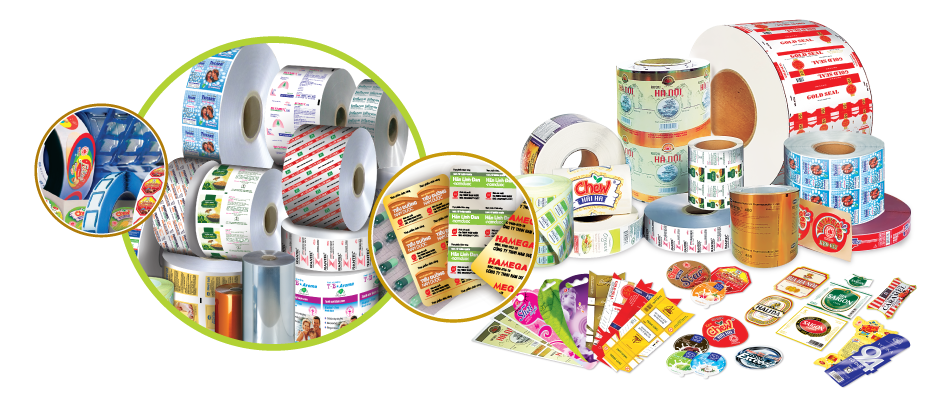
Flexographic printing has enormous applications in printing today. With many advantages, flexographic printing technology is often used to print product labels, packaging, paper bags, cardboard boxes, and products requiring continuous roll printing. It can print on many different surfaces and materials such as: paper, decal, fabric, metal film, nylon, glass, sheet metal, steel, cardboard, etc.
SOME TYPES OF FLEXO PRINTERS
- small format flexo printing machine
- large format flexo printing machine
- sheet-fed flexographic printing press
- single-color flexo printing machine
- 2-color flexo printing machine
- 3-color flexo printing machine
- 4-color flexo printing machine
- 5-color flexo printing machine
- 6-color flexo printing machine
- 8-color flexographic printing machine
- 10 color flexo printing machine
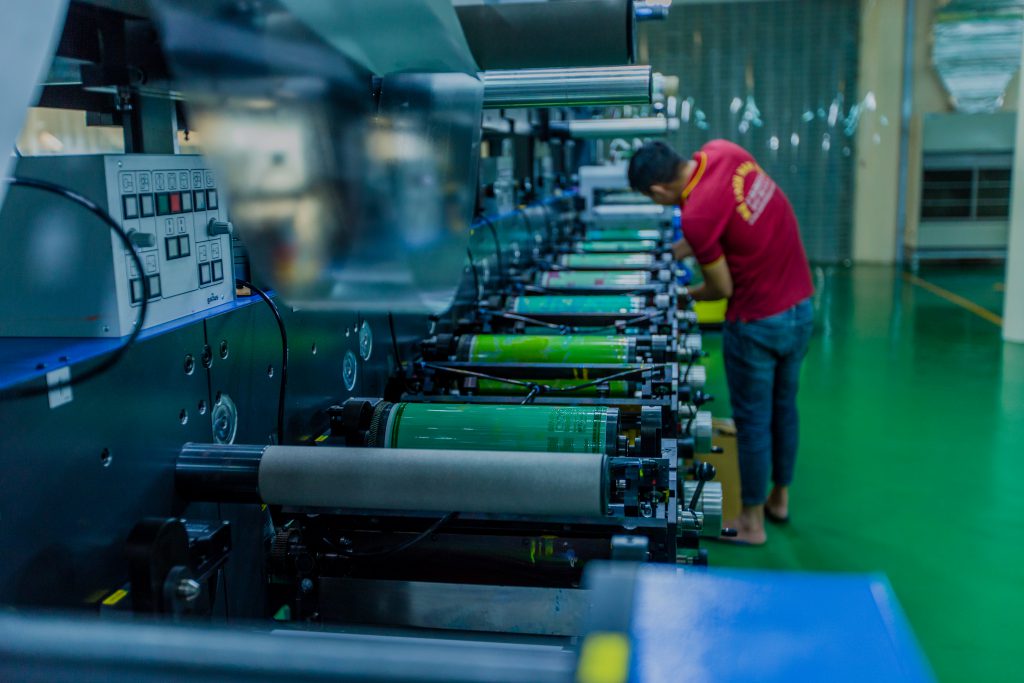
Contact NAM VIET for advice on large-format roll-form industrial label printing services using flexographic printing technology!
Share:


