


DIFFERENCES BETWEEN INCLINED AND FLATBED PRINT HEADS
What type of printing technology does your current printer use – near-edge printhead or flat-head printhead? Do you understand the differences between them? Are you interested in learning more? Let's explore the differences between these two printheads with Nam Viet Group.
The difference between a flat head and a near-edge print head lies in how the print head contacts the ink ribbon and media such as labels, tags, cards, etc.
With flat head technology, the print head lies flat and parallel to the media and ink ribbon. With this technology, the print head and ribbon travel together in parallel for a long distance before separating.
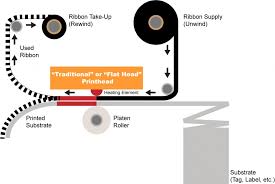
With near-edge printing technology, the print head makes very brief contact with the ribbon and media before separating. The print head is positioned at a 45° angle to the ink ribbon and media. This technology requires thermal transfer ribbons, also known as barcode ink ribbons, to be specially designed to handle the contact between the angled print head and the quick-connect ribbon and media. This is why it's important to understand and differentiate between near-edge and flat print heads when choosing the appropriate ink ribbon.
WHY IS IT IMPORTANT TO USE THE CORRECT INK RIBON FOR ANGLED PRINTERS?
In the field of thermal transfer printing, flat printheads are often considered slow and outdated, while some manufacturers such as Avery Dennison, Toshiba, and Source Technologies have adopted higher-quality, faster, and more stable tilted printhead technology.
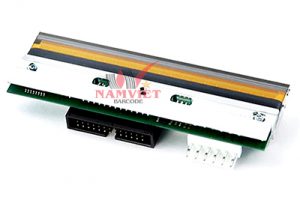
Both printheads use similar technology, where the image printed on the label is created from the heat and pressure of the printhead on the ink ribbon and the label surface. When the heat at the printhead is high enough, it contacts the ink on the label surface, melting the ink layer and causing it to adhere firmly to the label.
The print head is made of ceramic material—a material four times harder than steel, with good thermal conductivity, and contains thermal elements. The number of elements per inch of the print head determines the printer's resolution. As the ink ribbon and label move across the print head, these elements are switched on and off according to the print signal transmitted from the computer to print the image onto the label.
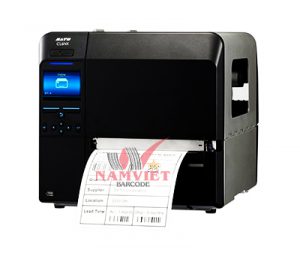
Although the printing technology is similar, there is a significant difference in the placement of the print head. As its name suggests, the flat head print head is positioned flush with the label. The thermal elements are designed to ensure light and rapid contact with the ink. This allows the ink to adhere to the label within a short time after passing through the print head.
The near-edge print head is tilted at an angle to the label and ribbon, with the thermal elements aligned along the print head, and the ribbon ink adheres to the label precisely at the print head's position.
Note: Ribbon ink needs to respond faster when using an inclined printer. Thermal transfer ribbon ink manufacturers make special ink ribbons designed for these applications – do not attempt a standard ribbon on an inclined printer.
Share:


