


INTEGRATING RFID TECHNOLOGY INTO LIBRARY MANAGEMENT
Library operations become faster and more efficient with the application of RFID technology. RFID technology for automated library management was first applied in Vietnam in the 2000s. However, at that time, the cost of this technology was too expensive, beyond the reach of most libraries nationwide. It wasn't until 2015 that universities such as the Vietnam National University Ho Chi Minh City, Vietnam National University Hanoi, Foreign Trade University, and the University of Transport began applying RFID technology for automated library management. Let's explore how RFID technology works in libraries through the information below.
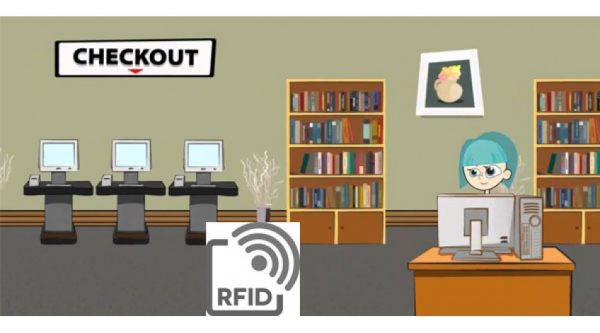
RFID is a technology that uses radio waves to identify objects. An RFID system consists of two main components: an RFID tag containing a chip that emits radio waves, and a reader with an antenna to receive the radio waves emitted from the tag and read the information on the chip.
ADVANTAGES OF RFID TECHNOLOGY FOR AUTOMATION IN LIBRARY MANAGEMENT
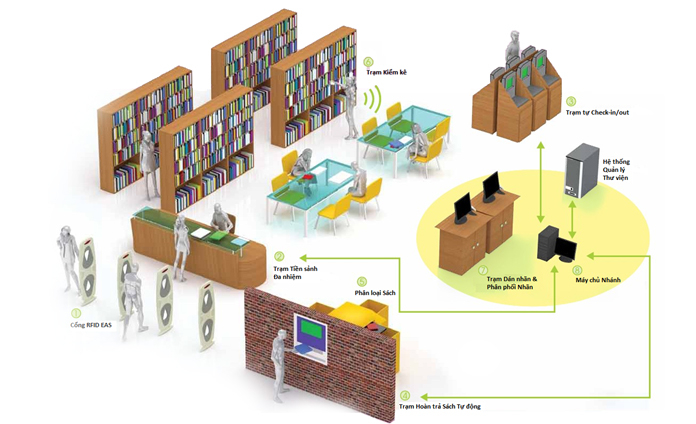
- No direct physical contact with the book is required. Automated RFID technology allows the code to be scanned from distances ranging from a few meters to tens of meters.
- Secure data identification and high security. With barcode technology, each tag only allows identification of document information. For theft prevention, users must use additional magnetic tags from the EAS security system. Meanwhile, RFID technology for automated library management allows for both of these features to be implemented simultaneously.
- Borrowing/returning multiple books at once. With barcode-based library management, you have to scan the barcode of each book individually when borrowing or returning them. But with RFID, you can scan multiple barcodes at once. RFID technology provides automated management, saving a lot of time in the management process.
- RFID tags are highly durable. RFID tags are more durable than barcode labels. RFID tag manufacturers guarantee that after being attached to books, the tags can be used for up to 100,000 borrowing/returning transactions before failing.
COMPONENTS OF RFID TECHNOLOGY FOR AUTOMATION MANAGEMENT IN LIBRARIES
RFID TAG
Before displaying books on shelves for readers, RFID tags must be attached. These tags are typically square or rectangular in shape, and contain a radio frequency chip.
LIBRARY STATION
After being tagged, each book has its information programmed onto a chip in the RFID tag. This information is then read by other devices in the system. Additionally, this is where readers can borrow/return books or resolve any issues that may arise. At this point, the librarian simply uses an RFID scanner and relevant software to process the borrowing/returning transaction.
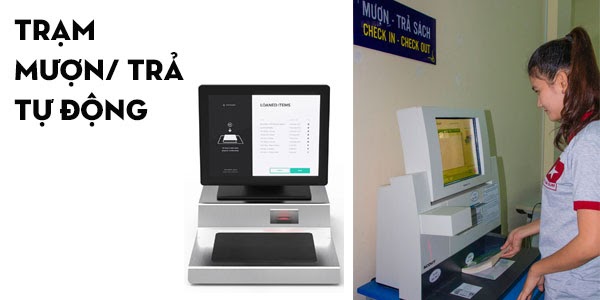

SELF-LIBERATION/BOOK RETURN STATION
The book borrowing/returning station offers a new user experience. Here, a touchscreen acts like a computer running software that allows readers to borrow/return books independently without the assistance of a librarian.
SECURITY GATE
The security gate operates based on radio wave identification. Therefore, when a book with an activated RFID tag passes through the gate, an alarm will sound. The anti-theft function of the security gate is disabled when the book is borrowed at the librarian's station or at stations with an automated book borrowing function.
PRINCIPLES OF OPERATION OF RFID TECHNOLOGY FOR AUTOMATION MANAGEMENT IN LIBRARIES

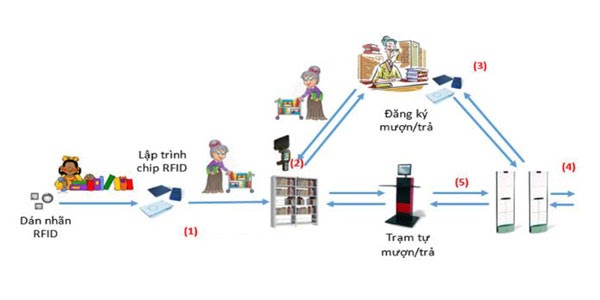
- (1) As shown in the image above, we see that after the books are brought into the library, they will be tagged with RFID tags, then sent for programming. The relevant information will be loaded when the book is ready to be borrowed (2).
You can choose to borrow/return books in 2 ways: - Borrow through the librarian station (3). Here, the librarian will check the book code through the RFID reader and confirm the book loan. At this time, the chip in the RFID card will be deactivated. At this time, when you take the book through the security gate (4), the alarm will not sound.
- Borrow at the self-borrowing/returning station (5). Here, borrowers can self-borrow/return books through instructions on the touch screen. The tasks are similar to borrowing/returning at the librarian station. Books will not have any problems when passing through the security gate after "checking out".
- Finally, after the book is returned, the librarian or automated borrowing/returning station will reactivate the RFID tag for the next borrowing/returning cycle.
—————————————–
To date, RFID technology for automated library management remains the most optimal method. It is hoped that libraries in Vietnam will continue to develop and receive adequate investment to provide the best possible experience for readers.
Share:


