


Investigating factors related to surface tension and surface energy in printing.
Surface tension and surface energy are two key factors that directly affect ink adhesion, especially in flexographic printing technology. Proper control of these two parameters not only improves print quality but also minimizes ink smudging and enhances image sharpness. To better understand how to optimize production efficiency, you can refer to the article from Nam Viet Group.
Wetability
Wetting ability plays a crucial role in flexographic printing, demonstrating how well the ink spreads and covers the material surface. When wetting is optimal, the ink adheres firmly and creates a uniform coating, preventing ink from dripping or smudging. This is especially important when handling materials that are difficult to absorb, such as plastic films, metals, or coated paper. If wetting is insufficient, the ink can easily slip or form small droplets on the surface, causing "fisheye" and negatively impacting print quality.
Surface Tension
Surface tension is the force between liquid molecules, creating a shrinkage film at the liquid's surface. This force causes the liquid to tend to shrink in surface area and is usually measured in units of dynes/cm² or mN/m². In flexographic printing, to ensure good ink adhesion to the material, the surface tension of the ink must be less than the surface energy of the material. If the surface tension of the ink is too high, the ink will easily shrink into small droplets, creating an uneven coating and reducing image sharpness. Additives can be added to the ink formulation to adjust surface tension, thereby improving wettability and increasing adhesion to the printing surface.
Surface Energy
Surface energy is a key factor determining the ink absorption and retention of a solid material. Measured in joules/m² or dynes/cm, the surface energy of the material needs to be higher than the surface tension of the ink to ensure even spread and coverage. When surface energy is high, the ink adheres more easily to the material, resulting in sharp and consistent prints. A common method for determining surface energy is measuring the contact angle between the material and the ink droplet. This technique helps assess the wettability and adhesion of the ink, thereby ensuring optimal print quality.
Measurement Methods
One common measurement method in flexographic printing is goniometry. This technique allows for the assessment of surface tension and surface energy by placing a drop of liquid onto the material surface and then measuring the angle of contact between them. A small angle of contact indicates that the ink easily penetrates the surface, demonstrating that the material's surface energy is high enough to hold the ink. Additionally, other methods such as ink testing or tackiness testing are used to evaluate wettability and adhesion. These methods help optimize technical factors in the flexographic printing process.
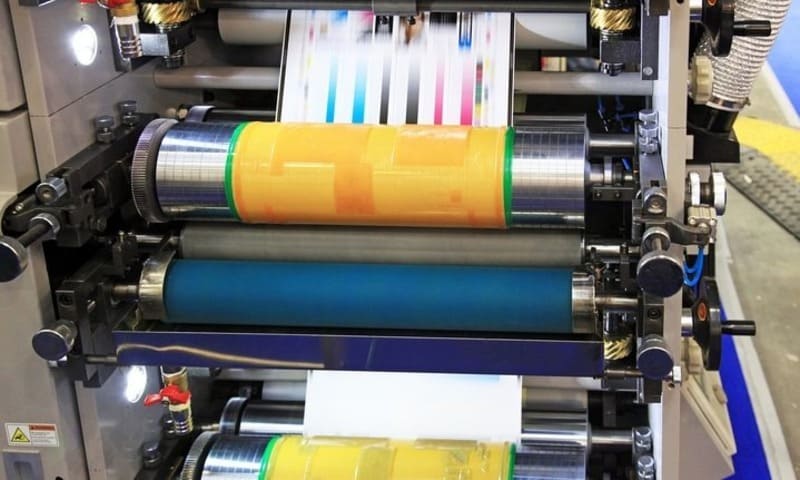
Flexo Printing Ink Supply System
In flexographic printing, the ink delivery system comprises three main elements: ink, image carrier, and printing material. To ensure good ink transfer from the image carrier to the printing surface, a balance between surface tension and surface energy must be maintained. Specifically, the ink must have a lower surface tension than the printing material, while the image carrier needs to have sufficiently high surface energy. At the same time, the surface energy of the printing material must also exceed the surface tension of the ink to ensure even ink distribution and adhesion without smudging or uneven ink coverage.
The influence of surface tension and surface energy on flexographic printing quality.
Incompatibility or improper adjustment between surface tension and surface energy can significantly reduce print quality. If the ink has high surface tension, it is prone to forming small droplets, causing "ink beading" and reducing the sharpness of the printed image. Conversely, if the material's surface energy is low, the ink will not penetrate the surface evenly, resulting in an inconsistent ink layer and reduced print quality. To improve this, surface treatment technologies such as plasma or corona discharge can be applied to increase the surface energy. This improves the wettability and adhesion of the ink.
Methods for improving and optimizing surface tension and surface energy.
Improvement solutions include surface treatment using plasma or corona technology to enhance the surface energy of the material. Additionally, adjusting ink formulations by adding additives to reduce surface tension, along with tight control of temperature and humidity during printing, are also crucial. These measures optimize wettability and increase ink adhesion, while minimizing printing errors and contributing to cost savings.
Mastering the principles of surface tension and surface energy will help optimize the flexographic printing process, resulting in consistent products with sharp images and high durability. Effective control of these two factors not only improves print quality but also optimizes production costs. Applying this knowledge will help you achieve outstanding success in all your printing projects.
Share:


