


[Learn] Advantages and disadvantages of UHF RFID tags
RFID tags use UHF and HF frequencies, each suited to different applications in various working conditions, warehousing, and transportation processes. Today, we will explore the advantages and disadvantages of UHF RFID tags.

What are RFID tags?
RFID is a technology that uses radio waves to read and collect information stored on tags attached to objects. High-frequency (HF) and ultra-high-frequency (UHF) RFID tags are used in the form of labels, tags, tickets, bracelets, and linked labels. They are designed and manufactured to be compatible with label printers so you can efficiently print and encode information. – a small electronic device consisting of a small chip, typically carrying 2,000 bytes of data or less, and an antenna.
See also: https://namvietgroups.com/en/tem-nhan-rfid-la-gi-co-nhung-loai-tem-nhan-rfid-nao/
What are UHF RFID labels?
Standard: ISO / IEC 18000-6C (EPC Gen2 C1).
Frequency: 860-960 MHz.
Antenna material: Aluminum.
Chip: H3.
Operating temperature: -20 ℃ ~ 80 ℃.
Reading distance: 1-3 m.
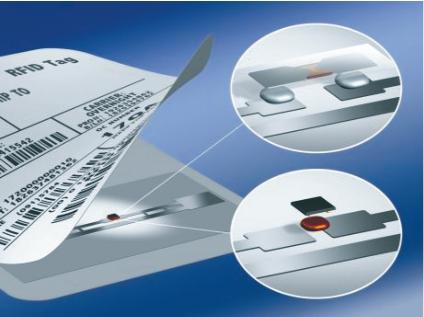
Advantages and disadvantages of UHF RFID tags
Advantage:
It can recognize objects moving at high speeds or read multiple objects simultaneously. It has the following advantages:
- Strong resistance to harsh environments.
- Strong protection and security.
- It is reusable and has a large memory capacity.
Standard UHF RFID tag protocol:
Currently, common UHF RFID airport gate protocols in China include international standards, national standards, industry standards, enterprise standards, etc. The most common standards are 6C and 6D standards, namely ISO/IEC 18000-6C (63), ISO/IEC 18000-6D (64) and China's national standard GB/T 29768-2013, which was officially implemented in May 2014.
UHF RFID tag frequency range:
Global definitions of UHF tag bands include different regions, such as:
- China's frequency bands are 840-844 MHz and 920-924 MHz.
- EU band 865 MHz ~ 868 MHz
- The Japanese frequency band is 952 MHz to 954 MHz.
- 920 MHz ~ 925 MHz in Hong Kong, Thailand and Singapore
- The frequency bands for the United States, Canada, Puerto Rico, Mexico, and South America are 902 MHz to 928 MHz.
Disadvantages:
Price, and unsuitable for certain environments.
Conclude:
Its advantages include the ability to read multiple tags at once, long recognition range, fast data transmission, high reliability and lifespan, and resistance to harsh outdoor environments.
It can be used in asset management, production line management, supply chain management, warehousing, anti-counterfeiting traceability of all kinds of goods (such as cigarettes, alcohol, medicines, etc.), retail, vehicle management, etc.
Share:


