


Overview of the flexographic printing process
Flexographic printing , also known as flexographic printing, is a printing process in which the image is created on a soft rubber sheet (easily bent along the axis of the roller) or photopolymer sheet with the image placed on the non-printing surface. The printing surface receives ink and transfers it onto the printing material. Because the ink is highly elastic, the transfer to the printing material results in a more beautiful finish.
Flexographic printing products, such as packaging, labels, and food packaging, are a strength of flexographic printing. Flexographic printing can print labels on many different materials such as: thin metal foil, fabric, paper, substrates, cardboard, laminated paper, and plastic film. Plastic film products are difficult to print on or very expensive. Although gravure printing is possible, the cost of gravure is very high and requires large print runs. Flexographic printing meets the requirements of low cost and small volume.
There are three types of flexographic printing machines in general: vertical stacking machines, planetary printing machines, and horizontal (in-line) printing machines.
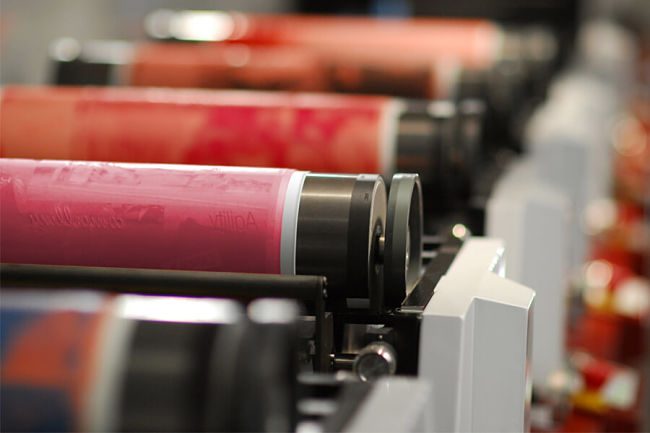
– Vertical stack label printers are a type of printer where the printing unit is stacked on top of one or both sides of the printer's main frame. They offer several advantages:
- There are many printing options.
- It can be printed on many things.
- Easily print one or two pages at high speed.
– A planetary (CI) printing press is a printing press with a printing cylinder located between the printing units, sometimes called a rotary drum printing press, and the printing parts are located around the cylinder. The cylinder's function is to support the paper and establish the precise color registration between the printing parts. The main advantage of a planetary printing press is its color accuracy.
– In-line printing machines: These have separate color printing units arranged in straight lines and connected by a common shaft, occupying a large working area. They are used for printing cardboard boxes, paper boxes, and various types of wallpaper…
Flexographic printing machines have four main components: the material supply system, the printing unit, the platen unit, and the output receiving unit. In the case of ink transfer, only the printing part is considered. There are two types: 3-axis and 2-axis.
- 3-axis design: The ink tube is made of rubber and guides ink through the anilox roller. The ink tube's rotation speed is fixed, but the ink roller's rotation speed varies, resulting in the ink tray not only transferring ink through the anilox roller but also sliding over it and wiping away excess ink. The amount of ink distributed in the 3-axis system is determined by the anilox roller's configuration.
- Two-axis design: instead of using ink cartridges, the anilox roller rotates directly within the ink trough and removes excess ink using a metal doctor blade. The doctor blade is parallel and angled at 30 degrees to the roller head; the doctor blade actually adjusts the amount of ink needed, but this will wear down the blade.
General structure of a Flexo printing machine
– The ink tray (rubber) is located in the ink reservoir and supplies the diluted ink. The ink tray and the anilox roller do not rotate at the same speed; the ink tray rotates slowly, resulting in the removal of excess ink from the anilox roller. The pressure and speed between the ink tray roller and the anilox roller differ significantly. This will wipe the ink away from the surface of the anilox roller so that ink remains only in the cells that have been loaded.
– The anilox roller (ink metering roller) is made of metal or ceramic, its surface marked with holes that guide a thin layer of ink to the printer. Cell frequency 80-170 lpi. The anilox roller provides a thin and fine ink flow. It is usually positioned at an angle opposite the wiper to remove the ink layer in a two-roll system. The anilox roller can have a ceramic or chrome finish. The ink holes on the anilox roller are machined into an inverted cone shape. Their density is given by the formula:
- V = h / 3 (Pa + Ab + VAt.Ab), where:
- + H is the depth of the pyramid
- + Pyramid opening
- + Ab is the volume of the base of the ink cell.
– The number of ink cells on the anilox roller is measured in BCM. 1 BCM is approximately 10 microliters. A suitable unit is micrometers³ / micrometers². The frequency of the anilox roller must be at least 3-4 times higher than that of the roller being printed.
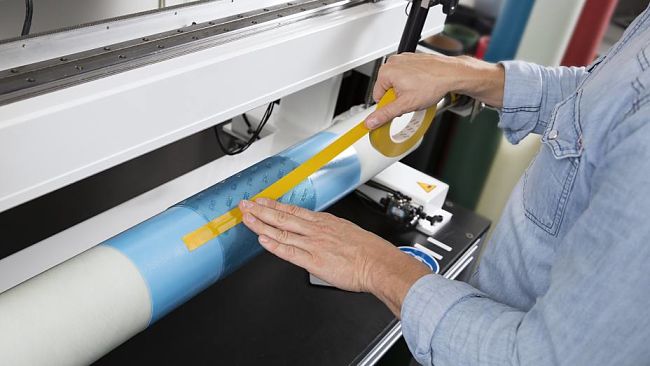
– Printing plate cylinder: usually made of steel and placed between the two anilox rollers and the press cylinder. The printing plate is attached to the cylinder with double-sided tape. The printing press rises to the surface and receives ink from the anilox roller, then transfers it onto the substrate material.
– Flexo roll: used for applying the printing plate, allowing for application in sections and the ability to change the printing plate depending on the size of the print.
Pressing roller: a highly polished and smooth metal roller. Its function is to connect the printing material to the printing plate.
For more details about our products and services!
Please call the hotline or click the register button.


Share:


