


RFID applications in library management.
Libraries around the world today face management challenges due to the steadily increasing density of library distribution points and data resources. In addition to ensuring the efficient use of library resources, front desk staff's daily tasks include communicating with readers and providing high-quality customer service, meeting the diverse needs of library visitors and readers.
RFID technology has solved these difficulties (which can also be considered the challenges mentioned above). With its "3-in-1" functionality of distribution, security, and inventory, RFID not only saves library staff maximum time but, more importantly, provides convenience and ensures the privacy of readers when using ATMs.

Applying RFID technology to library management.
Advantages of RFID implementation in libraries
- No direct contact with the book is required. RFID technology enables automatic code scanning from a distance of a few meters to several tens of meters.
- Secure and highly protected data identification. With barcode technology, each tag only allows identification of document information. For theft prevention, users need to use additional tags from the EAS security system. Meanwhile, RFID technology allows automated library management to simultaneously implement both elements.
- Borrowing/returning multiple books at once. In barcode-based library management, you need to scan the barcode for each book individually when borrowing or returning them. But with RFID, you can scan multiple barcodes at once. Automated management using RFID technology saves a lot of time in library administration.
- RFID tags are very durable. RFID tags are more durable than barcode labels. RFID tag manufacturers promise that, once the tag is attached to a book, it can be used up to 100,000 times for a single loan/repayment before defaulting.
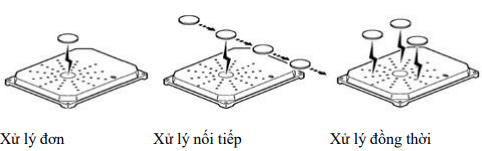
The device includes an RFID system.
School security gates: Operate based on the characteristics of radio waves. Therefore, an alarm vibrates when a document with an activated RFID tag passes through the gate. The anti-theft functions of the security gate are disabled when books are borrowed at the librarian's station or stations with an automated book borrowing function.
Library: After marking, the documents are organized with information on the chip on each RFID account. This forms the basis for other devices in this information system. Additionally, this will solve the problem of readers borrowing/returning books. In this case, readers must use RFID scanners and related software to process credit/return transactions.
Book borrowing and returning station: Introducing a new user experience. A touch-screen software program functions like a computer, allowing readers to borrow and return books independently without needing assistance from the librarian.
RFID Card Reader: Featuring cutting-edge RFID wireless technology, the FX 7500 stationery reader sets new performance standards – delivering superior performance with incredible readability and sensitivity anytime, anywhere.
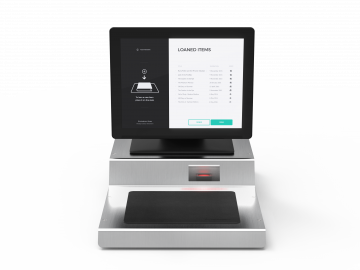
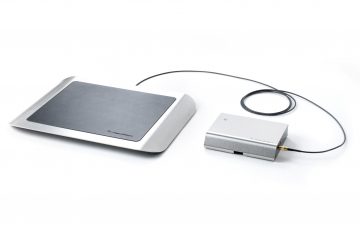
Before books appear on the shelves for readers, RFID tags must be installed. The book shelves are usually rectangular or square. Beneath these tags is a radio transmitter.
The operating principle of the RFID system used for library management.
(1) As shown in the figure above, we see that the books, after being added to the library, will be labeled with RFID tags and then sent for programming. The relevant information will be uploaded when the book is ready to borrow (2).
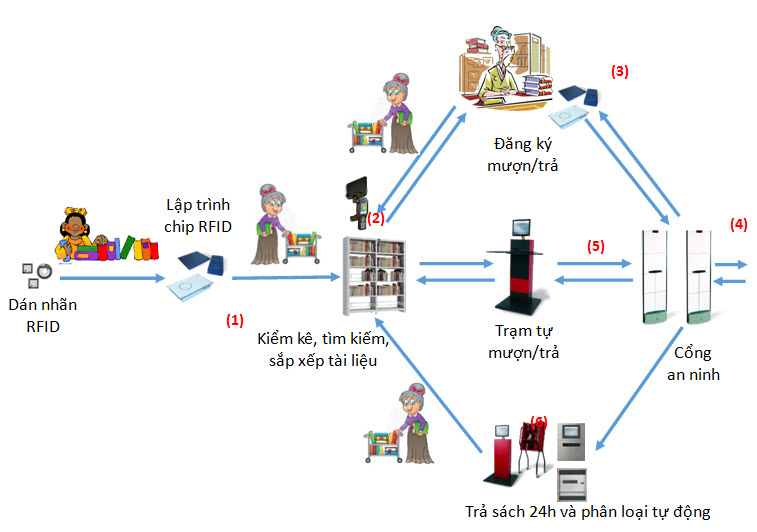
You can choose to borrow or return books in two ways:
- Borrow books through the library station (3). Here, the librarian will check the book's code via an RFID reader and confirm the borrowing. At this time, the chip in the RFID card will be deactivated. When you bring the book through the security gate (4), the alarm will not sound.
- Borrowing at the self-borrowing and returning station (5). Here, borrowers can borrow/return books themselves through instructions on the touchscreen. The process is similar to borrowing/returning at the librarian's station. Books, after being borrowed, have no problems passing through the security gate.
- Finally, after the book is returned, the librarian or book borrowing/returning station will reactivate the RFID tag for the next borrowing/returning cycle.
To date, RFID technology remains the most optimal method for library automation management.
Share:


