


The advantages of RFID technology over barcode technology.
Today, Nam Viet Group will explore with you the outstanding advantages of RFID compared to current barcode identification technologies.
It can be said that RFID and barcode identification technologies are currently two of the most popular technologies in the world for object identification. Although these two technologies are used for identification and have many similarities, we can still see the superiority of RFID technology.
Let's learn a little about barcodes. A barcode is information displayed in an easily visible form on the surface of a product or item. Each barcode corresponds to a sequence of numbers that acts as an identification code. Optical scanning devices, called barcode readers, can read barcodes, or they can scan images via specialized software.
RFID and barcodes both have their own strengths and weaknesses depending on the needs and purposes of use. Nam Viet Group will compare some characteristics of these two technologies to help you make an informed choice.
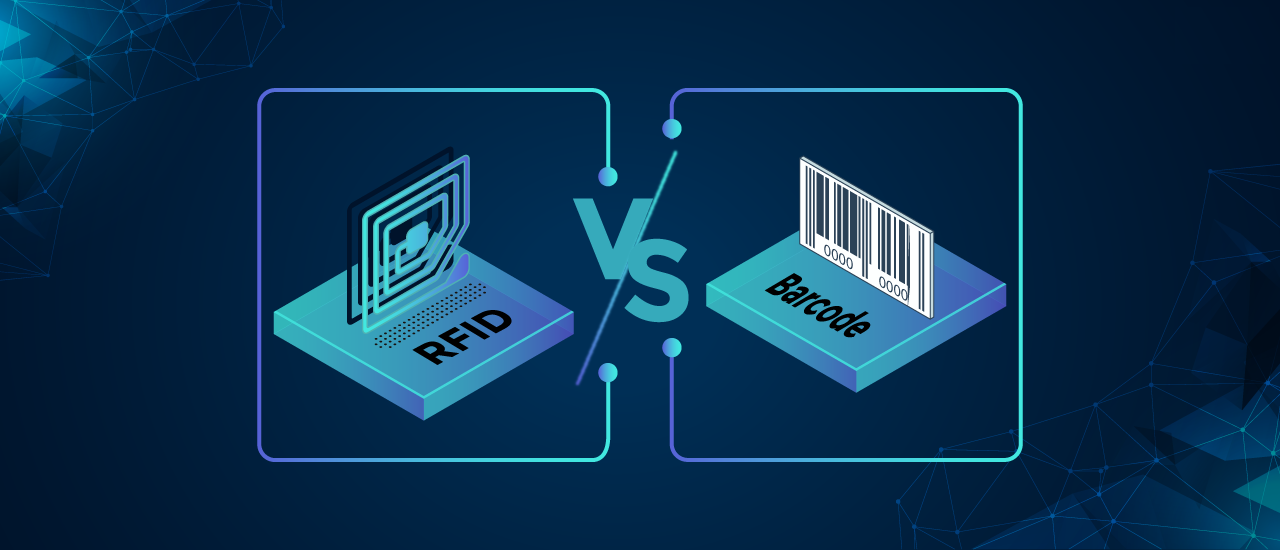
Data read and write capabilities:
Barcodes are fixed codes and cannot be modified once printed, so they can also be considered a read-only technology. RFID, on the other hand, is a technology that can read and write data to memory, with the tag being formatted thousands of times. The ability to modify data allows for the reuse of the tag, which is an advantage over barcode technology.
Memory size:
Current barcode recognition technology can store up to 2000 characters in 2D barcode format. This storage cost can be considered small compared to RFID tags, which have storage capacities of up to 128kB and can increase as memory gaps are reduced.
Great read:
Barcodes can be very long, typically several tens of centimeters. The reading range of RFID tags is quite wide, depending on the operating system frequency, antenna size, and the type of tag used. Generally, the maximum number of RFID tags can range from a few centimeters to several meters.
Line of sight:
When reading a barcode, it must be in the line of sight and not be blocked by anything. With RFID, however, there is no need for a barrier between the tag and the reader because the radio waves can propagate through many different objects.
Security:
The barcode is required to be printed on the outside of the packaging so that it can be quickly read from a phone, and anyone can collect the data stored on it. RFID, on the other hand, provides high security and prevents others from reading the tag; only the reader who provides the correct tag code can access the data.
High durability, stable reading.
RFID technology is resistant to dust and environmental pollution. Barcodes become unreadable if covered in dust or dirt. While barcodes sometimes need to pass through a system up to three times before being read, RFID, through collision-resistant algorithms and RW features, eliminates the need for repeated scanning. However, RFID does not work well in environments with radio wave barriers such as metal or liquids.
Price:
RFID offers many advantages over barcode technology; however, its high cost limits its adoption by businesses. Due to this high cost, RFID has not yet completely replaced barcode technology, and therefore, they remain incompatible.
Share:


