


What are RFID tags/labels? How to use them correctly?
RFID technology relies on radio waves to send and receive information between the label and the reader. At its simplest level, the RFID reader sends a signal to the RFID tag , and the tag sends back a signal carrying the information.
This unique information is provided as a GS1 Electronic Product Code™ (EPC) – which can be programmed into individual RFID tags that are then attached to products, boxes, pallets, or even high-value equipment depending on the application.

What are RFID labels/tags? What types of RFID labels and tags are there?
RFID technology can be understood as similar to barcodes; RFID tags are commonly used for rapid product-level tracking. However, because RFID tags use radio wave technology, they don't require a direct line of sight to be read – meaning entire pallets or loads of products can be read at speeds comparable to 700 products per second.
This gives RFID tags a clear advantage in enhancing supply chain tracking and optimization (known as smart label tracking).
Beyond benefits in distribution and supply chains, many brands are leveraging RFID tags to engage customers in experiences, allowing consumers to scan labels to access educational programs or product-specific pages.
Types of RFID labels
In terms of frequency range, RFID tags come in four different types:
NFC (near field communication): near field communication tags
LF (low frequency): low frequency
HF (high frequency): high frequency
UHF (ultra-high frequency): ultra-high frequency
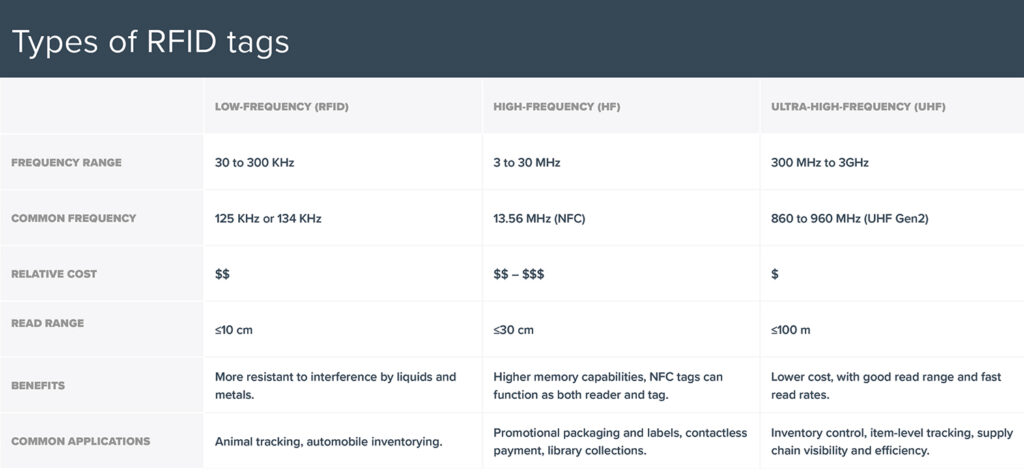
In terms of application, there are three types of RFID labels.
Active tags: powered – they have batteries and transmit signals cyclically, useful in location tracking applications (batteries in active tags can boost signal strength, and tags have a longer reading range, up to 100 meters). Being the most expensive, these tags are typically used to track very high-value assets, such as construction equipment, automobiles, or in healthcare applications.
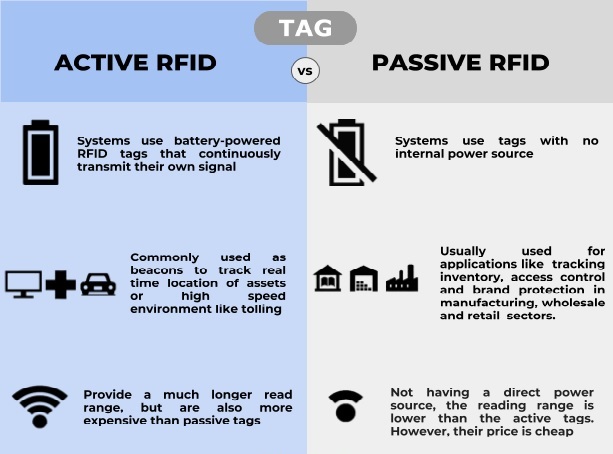
Passive: requires no power – the tag only activates when it receives a radio signal from the reader (energy from the reader signal is used to power the tag and transmit the information signal back to the reader), commonly used for tracking goods and pallets at a low cost.
Semi-passive: battery-powered – the tag has a battery but does not transmit signals cyclically like active RFID tags; instead, the battery is only used to power the tag when a signal is received – this allows all the energy from the reader's signal to be transferred back.
Share:


