


Working Principles and Applications of an RFID System
RFID (Radio Frequency Identification) is a technique for identifying and managing objects using radio waves.
It is an automated identification method based on remote data storage using RFID tags and an RFID reader.
RFID tags are used in many fields such as: object management, personnel management, retail goods management in supermarkets, botanical and zoological research, import and export goods management in factories or warehouses, vehicle management at toll booths, passport issuance, inventory, anti-theft, automatic timekeeping, parental monitoring of children, automatic identification, area security, seafood management, etc.
2. The working principle of an RFID system
A complete RFID system consists of four components:
1. Electronically programmed RFID tags
; 2. Readers or sensors to query the tags;
3. Antennas;
4. Host Computer.
RFID technology involves a wireless system that allows a device to read information contained in a chip without direct contact over a distance, without any physical communication. It provides a method for transmitting and receiving data from one point to another.
Block diagram of 1 Reader and 1 HF band Reader
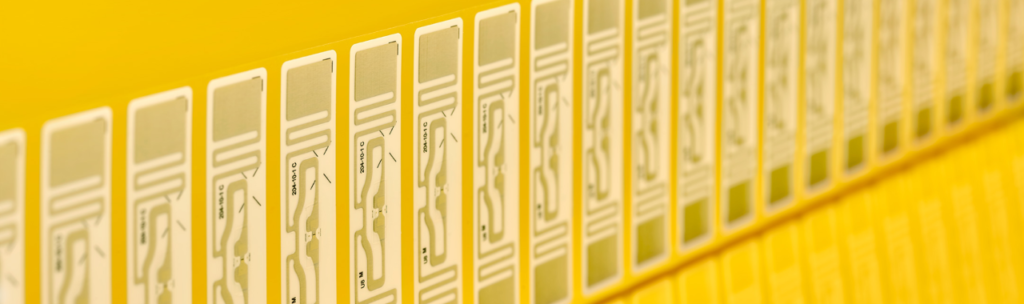
RFID tags consist of a small semiconductor chip and antenna, miniaturized into a package. Similar to television or radio broadcasting, RFID systems utilize four primary frequency bands: low frequency (LF), high frequency (HF), ultra-high frequency (UHF), or microwave. Modern supermarket systems operate on the UHF band, while older RFID systems used LF and HF bands. The microwave band is being reserved for future applications.
An RFID reader consists of an antenna that communicates with RFID tags, which are then networked to a host computer. The unit measures the relay signal between the host computer and all tags within the antenna's reading range, allowing a reader to communicate with hundreds of tags simultaneously. It also performs security functions such as encryption/decryption and user authentication. RFID readers can detect tags even when they are not visible. Most RFID networks consist of multiple tags and multiple readers networked together by a central computer. The host processes the data that the readers collect
from the tags and send back.
3. Applications:
Currently, RFID technology is applied in almost all areas of life, such as in the fisheries sector, import and export goods management, personnel management, vehicle management, and the US Department of Defense has also applied RFID technology on a large scale.
For example: When entering a supermarket to buy groceries, all goods are tagged with an RFID tag. Instead of standing in line for hours to pay, you can simply pick up your shopping bag and calmly leave the supermarket. An RFID reader will record all product price information as you pass by. RFID tags can replace barcodes on products sold in supermarkets. This helps supermarket managers instantly update all sold items and restock them without going through the inventory process. We also often see people wearing access cards; to enter or exit, they simply swipe the card on the door, and the door opens.
That's what RFID (Radio Frequency Identification) technology can offer.
Share:


